The global economy is undergoing a gradual but inexorable shift from developed to developing and emerging economies. Among the major developing economies, India, Indonesia and China will drive global growth over the next five years, but rapid growth in smaller emerging economies will equally create many new business opportunities. These economic shifts are broad, far-reaching and consequential — and must be the focus of careful consideration in boardrooms across industries and regions. Businesses must develop relevant ‘Strategic Markers’ as they frame their future plans.
Highlights:
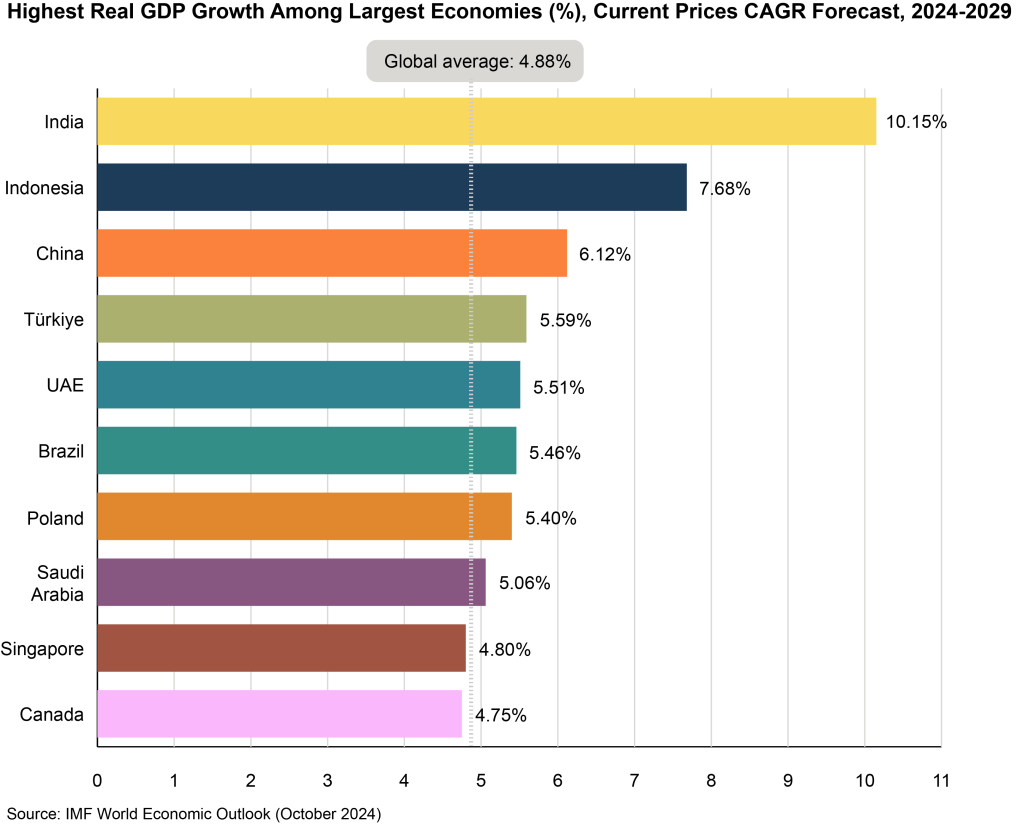
- The global economy is projected to grow at just below 5% from 2024 to 2029 in Real GDP at current USD prices. Several of the largest economies, led by India and Indonesia, could outperform the global average.
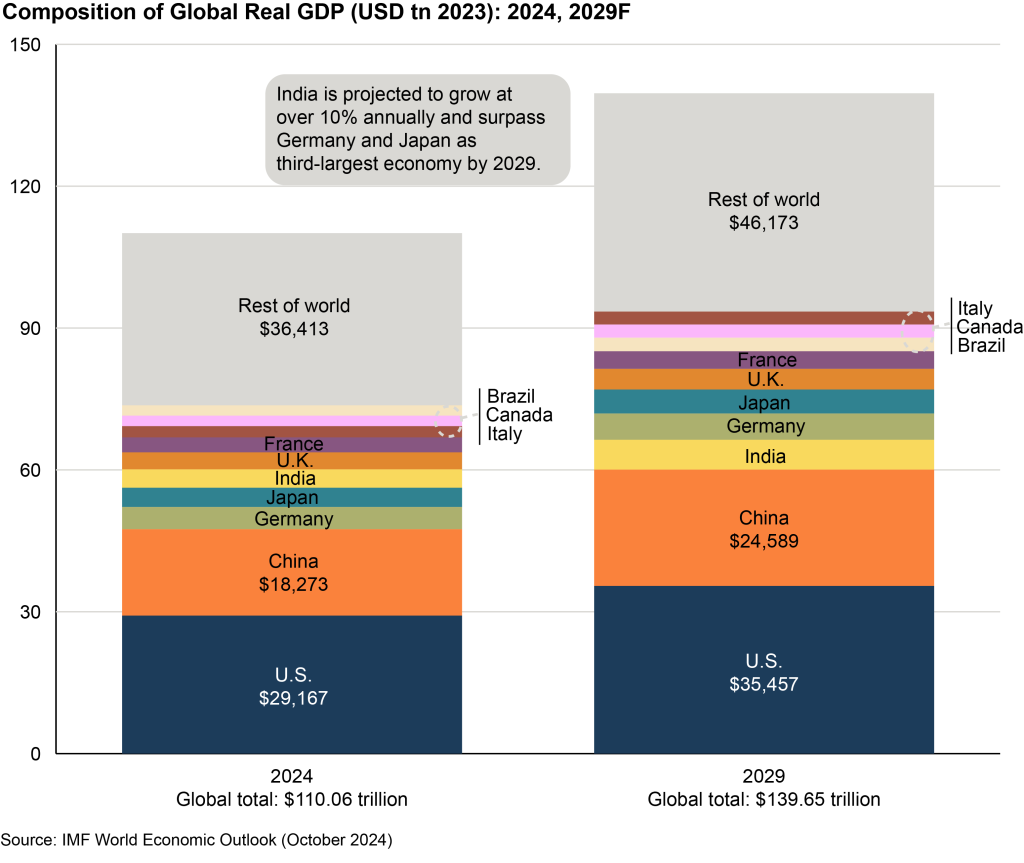
- In 2029, the U.S. and China will be the world’s largest economies, and India could be the third-largest, surpassing Germany and Japan.
- India will be the fastest-growing major economy over this period, with growth above 10%. Several smaller developing economies in Africa and Asia will exceed India’s growth rate.
- Developing ‘Strategic Markers’ will be crucial to aid businesses in developing future-proof strategies.
According to IMF projections, the global economy will grow 4.9% between 2024 and 2029 in Real GDP at current USD prices, from around USD 110 trillion to just under USD 140 trillion.* Among the largest developing economies, India, Indonesia, and China will outperform the global average, while many developed economies could fail to reach this level.
The U.S. and China will remain the world’s largest economies in 2029. The U.S. economy is projected to exceed USD 35 trillion after growing at 3.98% from 2024 to 2029. With a projected growth rate of over 5-6% over the same period, China will consolidate its position as the world’s second-largest economy, with GDP reaching USD 24.6 trillion.
India’s GDP is projected to increase from USD 3.9 trillion in 2024 to USD 6.3 trillion in 2029, and the country could surpass Germany and Japan as the world’s third-largest economy by 2029. Indonesia is projected to grow 7.7% from 2024 to 2029 to reach USD 2.2 trillion, which would make it the world’s sixteenth-largest economy, with Russia, South Korea, Australia, Mexico, and Spain ahead of it outside the top ten.
* This measures projections of GDP in Real current dollar terms from 2024 to 2029 using Compound Annual Growth Rate (CAGR), not annualized percentage changes in GDP growth projections.
India’s economy is projected to grow 10.2% from 2024 to 2029, more than twice the global average. Indonesia, China, Türkiye, the UAE, Brazil, Poland, and Saudi Arabia are also projected to outperform the global average over this period.
Several developed economies, including Switzerland, Japan, Spain, Australia, and the U.K., are projected to grow between 4% and 5%, just below the global average, while the U.S., Germany, France, and Italy are projected to grow between 3% and 4%.
When considering all countries, irrespective of size or stage of development, the fastest-growing economies from 2024 to 2029 will be relatively small developing economies in Africa and Asia. Five economies (Zambia, São Tomé & Príncipe, Uzbekistan, Uganda and Bhutan) will exceed 10% growth. Only India is projected to reach the same growth level among the major economies.
In Africa, Zambia’s economy is projected to reach almost USD 48 billion in 2029, with a growth rate exceeding 13%, underpinned by trade, agriculture, mining and household and corporate consumption. São Tomé and Príncipe is projected to grow at over 11%, but as its economy will only exceed a billion dollars in 2026, this growth is from a very low base.
In 2029, Uganda’s economy is projected to reach USD 93 billion, with over 10% growth driven by mining, construction and services. Other African countries with projected growth rates above 9% are South Sudan, Mozambique, Senegal and Niger.
In Asia, Uzbekistan’s economy is projected to reach nearly USD 190 billion in 2029, with over 11% growth driven by mining and minerals investment. India’s neighbors Nepal and Bhutan are projected to grow over 10%. In recent years, these economies have increased investment in hydropower energy, although agriculture retains a dominant role in both countries.
Other Asian countries with projected growth rates of 9% or higher are Bangladesh, Turkmenistan and Mongolia.
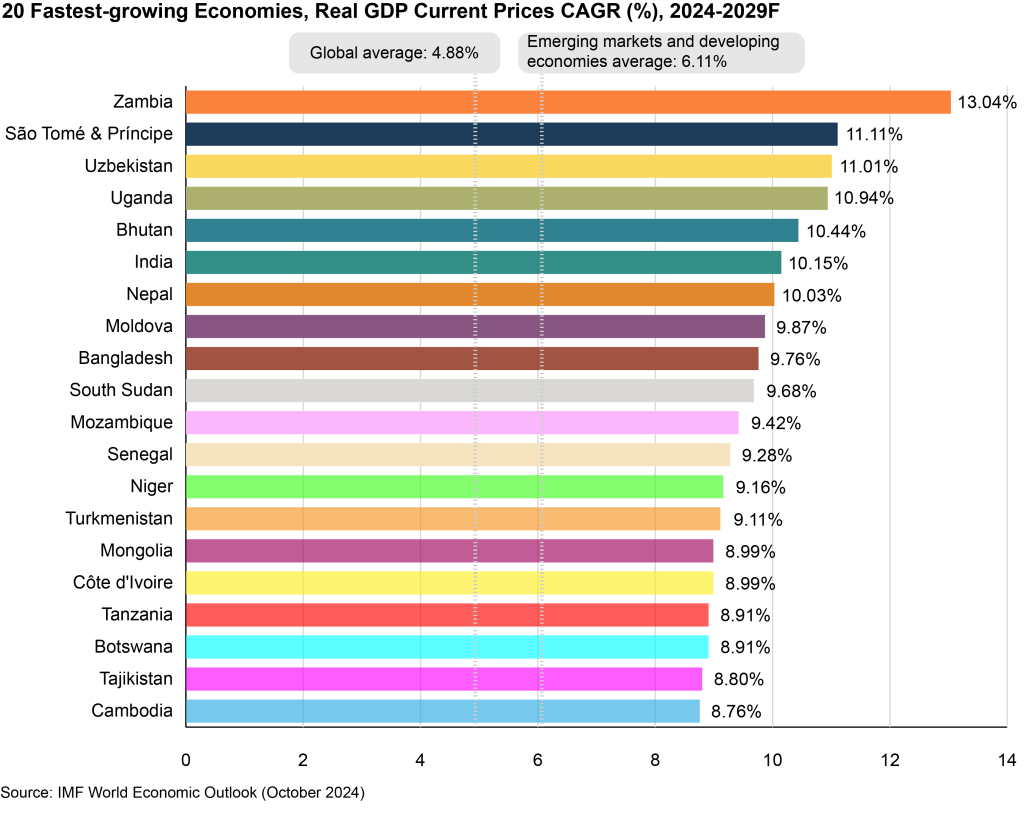
In Europe, Moldova is projected to be the fastest-growing economy at just below 10%, as structural reforms are being implemented toward the country’s EU accession, currently scheduled for 2030.
The shifting composition of the global economy reflects a gradual rebalancing of economic power. From 2024 to 2029, North America’s share of global GDP is projected to decline from 30.03% to 29.05%, while Europe’s share could decrease from 24.62% to 23.30%. The Asia Pacific region is projected to increase its share from 34.84% to 37.22%.
The share of emerging market and developing economies in global GDP could increase from 41.23% to 43.71%, while advanced economies could decrease from 58.77% to 56.29%.
Are you selling to, buying from or entering the right markets?
With Asia’s increasing dominance, the enduring importance of the U.S. and China, and shifting dynamics in Europe and Africa, it is crucial for businesses to ensure they are targeting the right markets with the right strategies.
To successfully navigate these changes, consider the following ‘Strategic Markers’:
- Adapt strategies for the U.S. and China: Develop flexible strategies that respond to the specific economic conditions and consumer behavior in these crucial markets. Both of these two ‘largest’ global markets are about to go through an intense period of cyclical, structural and policy adjustment (regulation, de-regulation and re-regulation). Many opportunities and risks are going to be revealed.
- Capitalize on Asia’s growth: Prioritize expansion into key Asian markets, particularly technology, consumer markets, services and industrial goods. Recognize the differences between developed, developing and emerging Asia.
- Explore new opportunities in developing and emerging markets more broadly: Beyond traditional markets, consider new opportunities in regions like Africa, Latam, Eastern Europe and the Middle East that are increasingly contributing to global trade. The past 10 years have heralded a different phase in these markets but the next 10 years will see even more rapid transformation.
- Strengthen supply chain resilience in tapping new global regions: Ensure that your supply chains are robust. Entering new markets is risky and complex. Do not overreach — and expand at a measured pace with all risks managed to handle disruptions, particularly in sectors such as energy and chemicals, which remain vital to global trade.
- Develop capacity and talents: Build teams that can operate in new environments where the business needs to go. Develop and retrain existing teams to adapt quickly to new conditions and working methods. Appreciate that having the right people and skills will represent an advantage.
- Invest in R&D for technology-driven sectors: Given the dominance of machinery and electronics in global trade, investing in innovation and staying ahead of technological trends is critical. Do not believe ‘our business will not be affected.’ Almost all businesses have to innovate and leverage technology; certainly, all international businesses must do so to gain or maintain an advantage.