The global trade environment is evolving at an unprecedented pace as developing and emerging markets rise, traditional powerhouses adapt and new trading relationships reshape the economic landscape. Astute export managers must identify and manage a host of new opportunities.
Highlights:
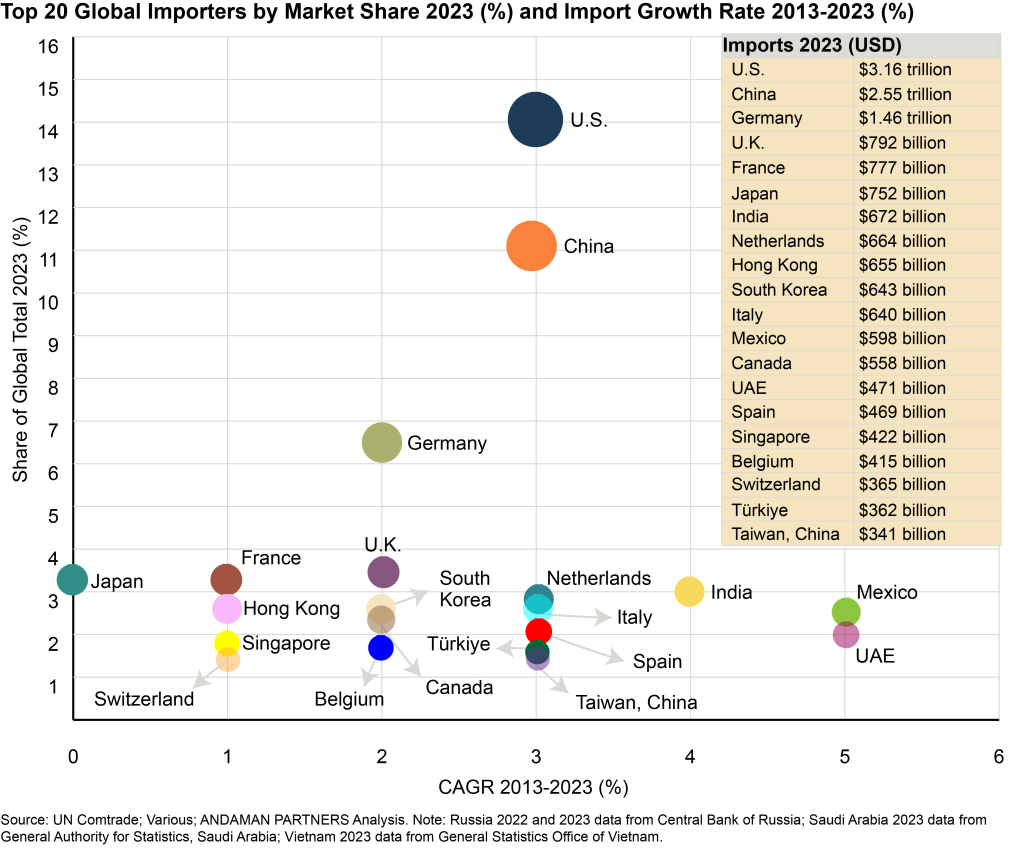
- The world imported USD 22 trillion of goods in 2023, a 7% decline year-on-year. The top 20 importers dominated with a 74% market share, showcasing the continued concentration of global trade in a few major economies.
- Machinery, Electronics & Metals accounted for 37% of global imports, followed by Minerals, Fuels & Chemicals at 24% and Transport Vehicles at 9%, collectively representing 70% of total imports.
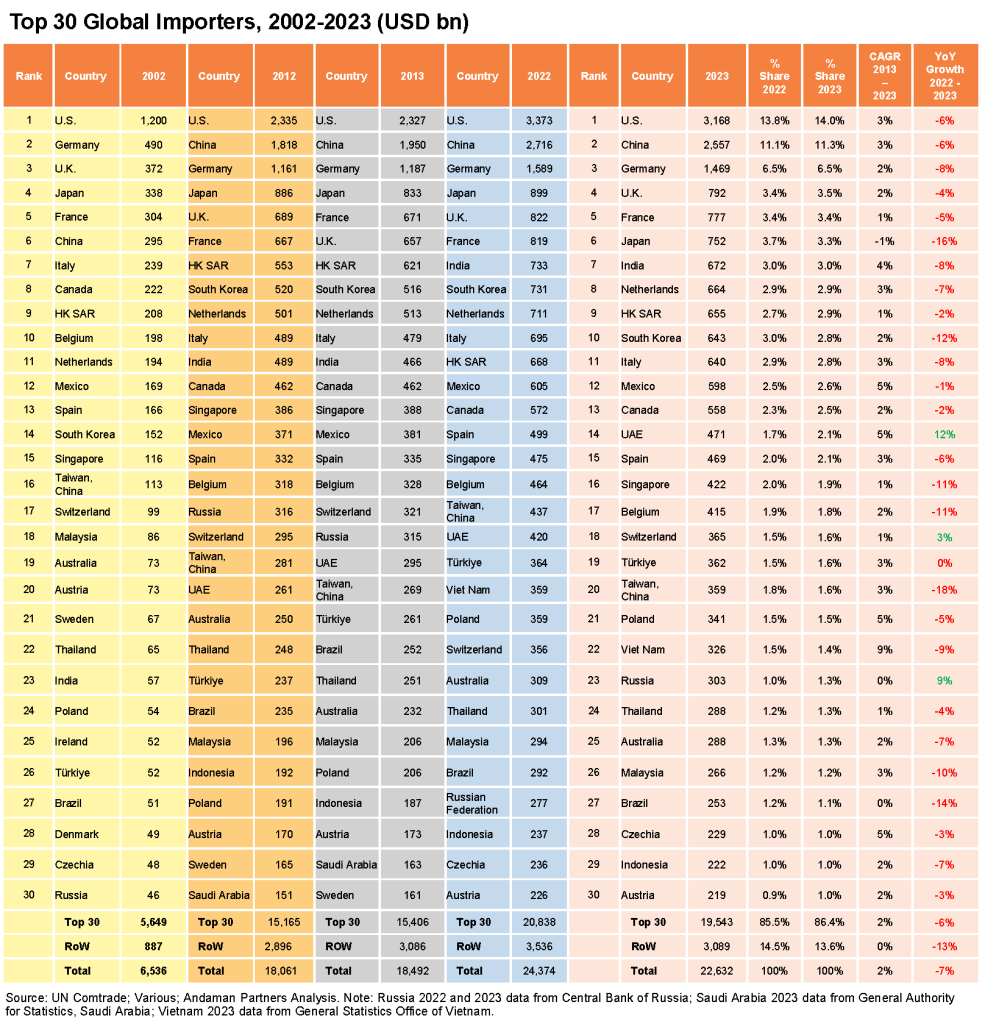
- Vietnam achieved a 10% CAGR in imports from 2013 to 2023, climbing ten places in the global import rankings to 22, while the Philippines rose 12 places to 35. India moved up four places to become the seventh-largest importer.
- South Africa saw the steepest drop in import rankings, falling seven places to 40. Russia and Brazil dropped five places to 23 and 27, respectively, due to geopolitical tensions and weak industrial performance.
- The “China +1” strategy and regional agreements like RCEP and USMCA have driven diversification, benefiting emerging economies like Vietnam and India while reducing over-reliance on traditional powerhouses like China.
The world imported around USD 22 trillion worth of goods in 2023, a 7% decline from 2022, reflecting a moderate 2% compound annual growth rate (CAGR) over the last decade (2013-2023). The top 20 importers continue to dominate, accounting for 74% of total imports. This concentration underscores the challenges developing markets face in competing with established economic powerhouses.
In 2023, the U.S., China and Germany maintained their positions as the top three importers, contributing 32% of global imports. Their dominance stems from large industrial bases, robust technological sectors and high consumption-driven economies.
However, emerging economies are rapidly gaining ground. Vietnam, for example, has climbed an impressive ten places to 22 in the last decade, driven by a 10% CAGR in imports from 2013 to 2023. Its success is driven by export-focused industries such as electronics and textiles and strategic shifts like the “China +1” strategy, encouraging firms to diversify supply chains away from China.
Other rising players include the Philippines, India, Mexico, the UAE, Nigeria and Poland.
Upshot:
- Rising stars Vietnam and the Philippines: Vietnam and the Philippines climbed 12 and 10 places, respectively, in global import rankings between 2013 and 2023, becoming important players in global trade. Vietnam’s rise is tied to its role as a manufacturing hub, while the Philippines has seen growth in consumer goods and agricultural exports.
- Strategic moves by Poland, India and the UAE: Poland and the UAE rose five places each, to 21 and 14, respectively, and India advanced four places to become the seventh-largest importer in 2023. Strategic trade networks, industrial growth and high consumer and capital goods demand fuel their success.
- Strong growth in Mexico and Nigeria: Mexico strengthened its trade ties with the U.S., particularly in transport equipment, while Nigeria climbed seven places, driven by modernization and infrastructure investment.
- Challenges for South Africa, Russia and Brazil: South Africa’s seven-place decline to 40 highlights economic challenges, while geopolitical tensions pushed Russia down five places to 23. Brazil’s sluggish industrial performance also contributed to its five-place drop to 27.
Import sectors
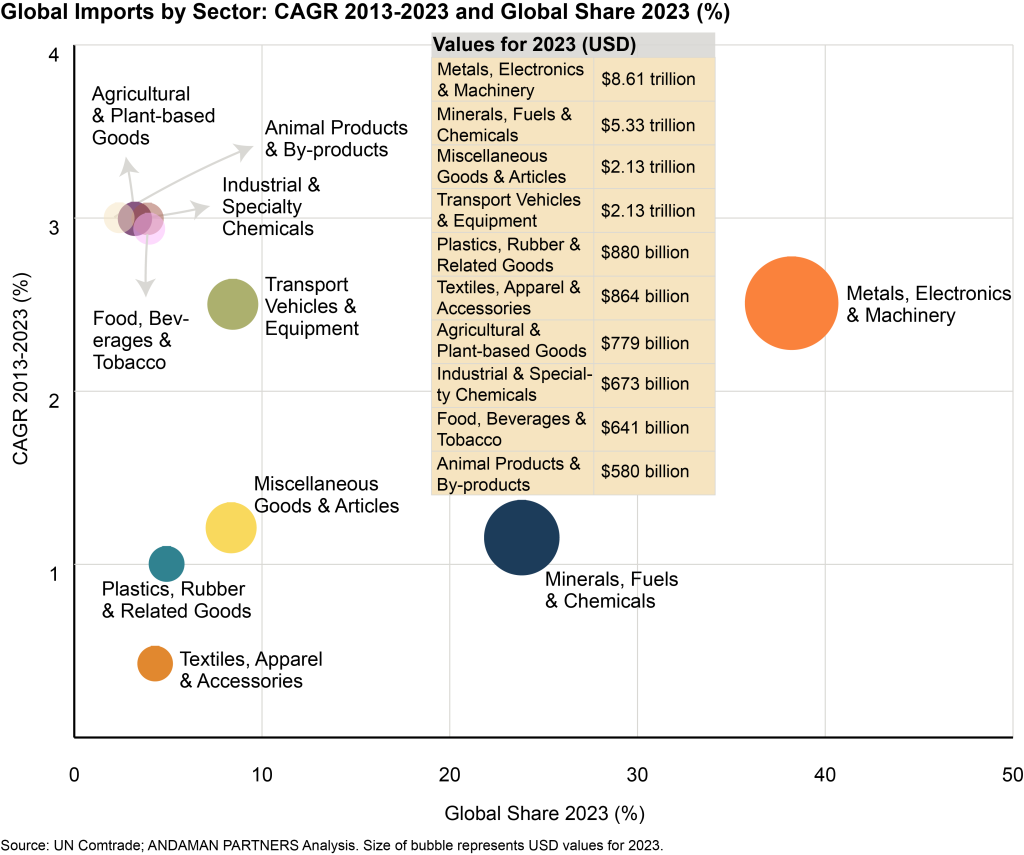
Global imports in 2023 were dominated by three key sectors: Metals, Electronics & Machinery (38%), Minerals, Fuels & Chemicals (24%), and Transport Vehicles & Equipment (9%). The top three sectors accounted for USD 16.1 trillion or 70% of global imports, reflecting robust demand for infrastructure development, technology and consumer goods.
Consumer goods and intermediate products also saw rapid growth, particularly in emerging economies across Asia and Africa, driven by rising per capita income and demand for integrated supply chains.
Upshot:
- Dominance of Metals, Machinery & Electronics: This sector accounted for 38% of global imports in 2023, highlighting its critical role in industrial economies.
- Growth in Transport Vehicles: The transport sector reached USD 2.1 trillion in 2023, with a 2.6% CAGR over the last decade, driven by demand for automobiles and heavy machinery.
- Shifts in energy: Minerals, Fuels & Chemicals, while still a significant sector, grew at a slower CAGR of 1.2%.
- Industrial & Specialty Chemicals: This sector grew at a robust CAGR of 3.4%, driven by applications in manufacturing and high-tech industries.
- Moderate growth in textiles & plastics: Textiles and apparel saw slow but steady growth, while plastics grew by 1%, reflecting lower demand for packaging and industrial plastics.
New opportunities and partnerships in a changing trade landscape
Regional trade patterns highlight interconnectedness and diversification. The U.S. relies heavily on machinery and electronics imports from Mexico, while Germany and Poland dominate the EU’s industrial trade. In Asia, China’s import demand for agricultural goods and metals supports its manufacturing and consumer-driven economy. The UAE has emerged as an essential hub for mineral and fuel imports, leveraging its importance as a geographic and logistical hub.
The “China +1” strategy has spurred companies to diversify their sourcing and production bases, benefiting emerging markets such as Vietnam, India and other Southeast Asian nations. Regional partnerships like the Regional Comprehensive Economic Partnership (RCEP) in Asia and the U.S.-Mexico-Canada Agreement (USMCA) in North America are reshaping trade flows and reducing supply chain vulnerabilities.
The global trade environment is in flux, with new players emerging and traditional powerhouses adapting to evolving economic realities. Key sectors like machinery, electronics and transport equipment will continue to dominate imports, driven by industrial and consumer demand. At the same time, the rise of emerging markets and regional partnerships presents opportunities for businesses to adapt to a more diverse and interconnected global trade network.
Investing in resilience, emerging markets and strategic partnerships will be crucial for companies to thrive in this dynamic landscape. Accordingly, the following is a list of priorities for international export managers:
- Leverage data, analytics and strategic intelligence for success. Invest to ensure high-quality internal organizational and external market data for better decision support.
- Anticipate general changes and trends in global markets as early as possible, such as the decline in traditional markets and the emergence of demand growth in new markets. Act early and diversify export portfolios to adapt to changing conditions.
- Develop team skills and human capital to flourish in a changing world with increased risk, uncertainty, ambiguity and more open international supply chains. Adapt hiring and professional development to align with the new realities in global markets where multiple languages, cultures, time zones and variables are pervasive.
- Develop organizational capabilities across the company that support international business better, e.g., global risk management, international logistics management, a collaborative mindset, partnerships and flexible business models.